Aircraft: BAe146 - FAAM
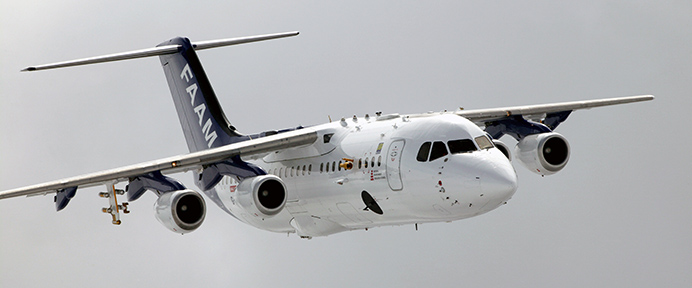
Dimensions
- Length: 31.0 m
- Height: 8.58 m
- Wingspan: 26.0 m
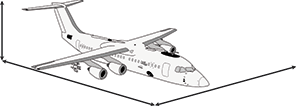 31.0 m
8.58 m
26.0 m
31.0 m
8.58 m
26.0 m
Flying performances
Speed| Min speed | 80 m/s |
| Max speed | 215 m/s |
| Usual speed during measurements | 100 m/s |
| Usual speed during transit flights | 170 m/s |
| Ascent rate | 5 m/s |
| Min altitude |
|
| Max ceiling | 35 000 ft |
| Usual ceiling during measurements | 30 000 ft |
| Ceiling limitations | maximum FL280 in cloud |
| Empty weight | 25 400 kg |
| Max take-off weight | 42 000 kg |
| Max payload | 16 600 kg |
| Max scientific payload | 11 000 kg (X-coordinate of 2nd point) |
| Usual scientific payload during measurements | 4 000 kg |
| Scientific payload for max endurance | 1 100 kg (X-coordinate of 1st point) |
Endurance
| Max endurance at min scientific payload and max fuel | 6 h (Y-coordinate of 1st point) |
| Endurance at max scientific payload | 2 h (Y-coordinate of 2nd point) |
Range
| Max range | 3 700 km (at min scientific payload and max fuel) |
| Conditions for max range |
at FL290, 220 kts |
| Range at max scientific payload | None km |
| Usual range during measurement flight | 3 000 km |
Other
| Weather conditions limitations |
Generally minimal |
| Take-off runway length | 2 000 m |
| Engines | 4 x Honeywell LF507 |
| Avionics | yes |
Crew and scientists on board
| Crew (pilots + operators) |
2 + 1 |
| Seats available for scientists | 18 |
Cabin
| Length | 19 m |
| Width | 3.45 m |
| Height | 2.20 m |
| Apertures | main doors : W0.86 m x H1.78 m (two forward, two afterward). |
| Cabin pressurized | yes |
| More information | no |
Aircraft modifications
| Nose boom | no |
| Windows | Upper and lower lidar windows in real fuselage. Standard fuselage windows can be replaced by mountings for lightweight instruments. |
| Openings | yes |
| Hard points | Range of hard points for intakes around the forward fuselage. Hard point under each wing (outboard of engines) carrying pylon with 5 mounting locations for standard PMS/DMT canister instruments. |
| Inlets | yes |
| Additionnal systems | Aerodynamic external blister on port forward fuselage, containing 3 bays for mounting radiometers. Instruments in blister have views of both zenith and nadir. Bays can be adapted to a range of instrument mountings. |
Acquisition systems
n/c
Electrical power
| Aircraft total electrical power (kW) | n/c |
| Electrical power (kW) and voltages (V) available for scientists | 40 kW total, comprising 115 VAC (400Hz), 28VDC and 240VAC (50Hz). |